Cncjerry wrote:
So adding a pulley giveth; adding a cam taketh away, no?
You don't get both at the same time, what you get is slope, and you end up "better distance" when first applying the brake and then better leverage as you pull the handle in.
Which is exactly what you want, a shorter leaver to bring it in contact, then a longer leaver as you ask for more braking power.
Let me try and verbally explain it.
If you look at the one that jwilliams built, the pulley is off to the right of the brake arm.
Al's is a pulley that is mounted off center to the left, about 3/4 or more of the way to the edge, and has an extra anchor point where you place a standard cable trunnion to keep the pulley from rotating out of position.
You arrange the pulley so it's starting point is below the stock anchor, say 8 o'clock or so, using the brake arm pivot point as the center of the clock and the trunnion slot as the hour hand. So at this point, you get more distance but less leverage, engaging the brake to the surface.
As you pull the brake, it rotates and makes the effective arm longer, giving more leverage and applying more pressure to the shoes.
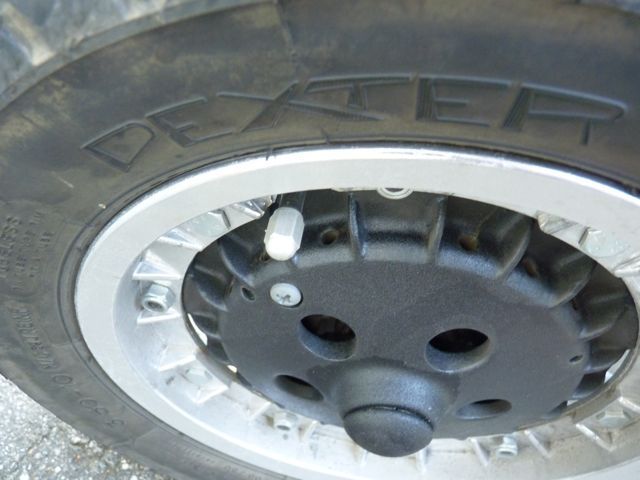
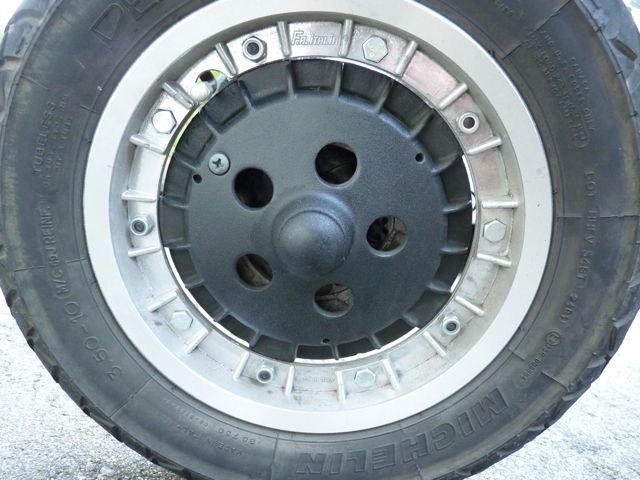
As for the leading edge question... I am sure that it does contact it differently, but it does not pulse any more than a stock one does. Again, the angular speed is about half the road speed, so those slots are going by at 15mph, or about 22rps, or 110 contacts per second.
It does wear them out faster, much faster. The surface gets scoured and never glazes over.



 I'm guessing Al got straight 'A's in geometry.

